The Unethical Truth About Chicken Farms: Factory Farming

Updated: Jun 1
A chicken farm is not what many people might picture: nice green fields with chickens roaming outdoors, plenty of space, pecking at food on the ground, and being treated with respect by a farmer. This is sadly far from reality.
Chickens are the most farmed and killed land animals on the planet. On any given day, there are roughly 33 billion chickens on Earth, and 99% of them are confined indoors, doomed to misery until they are killed 6–8 weeks later. (Source: Sentient Media)
The Reality of Chicken Farming
There are factory farms for layer hens (egg-producing farms) and for broiler chickens (meat-producing farms), each using a different breed of poultry. There are even specific facilities called breeding factories, the sole purpose being to produce fertilized eggs and breed more chickens. In all of these factories, no matter the type, chickens are treated as though they are not living beings.
In egg-producing farms, chicks are born indoors in hatcheries, where they are separated by gender on a conveyor belt. The female chicks are kept alive, while the male chicks are mechanically ground up alive, a process called maceration. Since they cannot produce eggs, they are deemed useless (Source: RSPCA). For the female chicks that survive, this is only the beginning of their short lives. They are abused and exploited for everything they can possibly give, then killed as soon as their natural egg production begins to decline and they are no longer considered financially profitable (Source: Piedmont Refuge).
The Broiler Chicken Industry
In meat-producing factory farms, a different breed of chicken is used. These so-called broiler chickens are selectively bred into unnaturally large birds with overgrown muscles, specifically for human consumption. Both male and female broiler chickens are fed genetically modified feed and bred to grow as quickly and as large as possible (Source: Humane League). As a result, many become so heavy that their legs break beneath them, leaving them unable to stand or walk properly.
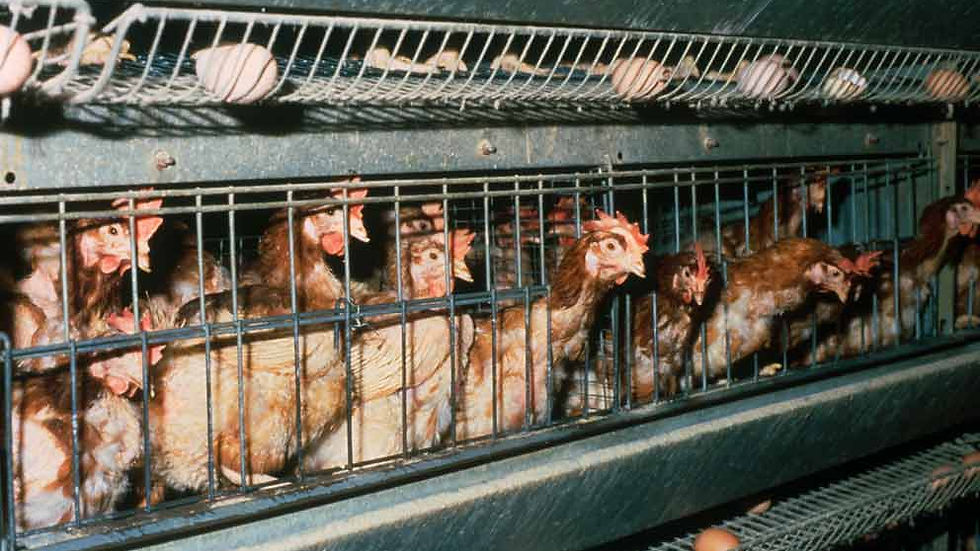
Different labels deceive us into thinking some chickens may live better than others. Unfortunately, "cage-free" simply means they are not placed in small wire cages with 6–8 other hens at a time. In most cases, chickens are placed in these "battery cages" for most of their lives, unable to move, overcrowded with other chickens, on a slanted floor so that when they lay an egg it falls safely. And in a "cage-free" environment, they are still born indoors, mass contained, thousands put together in a greenless space.

How Many Chickens Are Factory Farmed?
While people argue they can buy chicken and eggs from more "ethical" sources, unfortunately, this represents only around 1% of the poultry people actually consume. According to World Animal Protection, "Around 2,000 meat chickens are slaughtered every second around the world." Two sources confirming this reality: Our World in Data and World Animal Protection
Read that again. Every second "2,000 meat chickens are slaughtered".
This means roughly 120,000 chickens every minute.
Which means: 7,200,000 every hour.* -- EVERY HOUR.*
The number of chickens killed per day is disgraceful, reaching an average of 170 MILLION per day.
According to the Sentience Institute, their US Factory Farming Estimates show that 99% of chickens raised for meat (broilers) and over 98% of egg-laying hens in the United States live on factory farms, also known as Concentrated Animal Feeding Operations (CAFOs). These are "intensive, high-density operations that represent the vast majority of poultry production" (Source: Sentience Institute).
Many of these facilities hold over 100,000 chickens at a time. Most of these animals never see natural sunlight. For meat, they are pumped with hormones or selectively bred to grow into unnaturally large birds and live only 6-8 weeks before being killed.

We can see that in ONE factory farm there can be tens of thousands of chickens at once. Imagine 100,000 chickens crammed into a building that is hot, filthy, and overcrowded. Some suffocate due to a lack of space, while others are forced to live beside dead chickens left decaying on the floor.
Eating chickens raised in these systems can never be ethical. From the moment they are born, forcefully by humans, they are used and exploited in ways that benefit no one but the companies making profits from us, the blinded consumers.
The Need for Change
Factory farming is a side of the animal industry that is briefly known about, but not talked about or shown enough.
Chickens are no longer born outdoors; they are born and raised entirely inside industrial facilities, often in small wire cages, where they are forcefully reproduced and manipulated for corporate profit and overconsumption.
It is important to be informed about the cruelty happening behind closed doors and within these industrial farming systems. This cannot continue any longer. No animal deserves to be forcefully reproduced and subjected to such horrid living conditions.
The only way to end these horrors is to stop it completely. We must advocate for change and support practices that prioritize animal welfare. Together, we can create a more humane world.
Let’s make informed choices and inspire others to do the same. By understanding the realities of factory farming, we can drive systemic improvements that benefit animals, our environment, and our health.

Comments