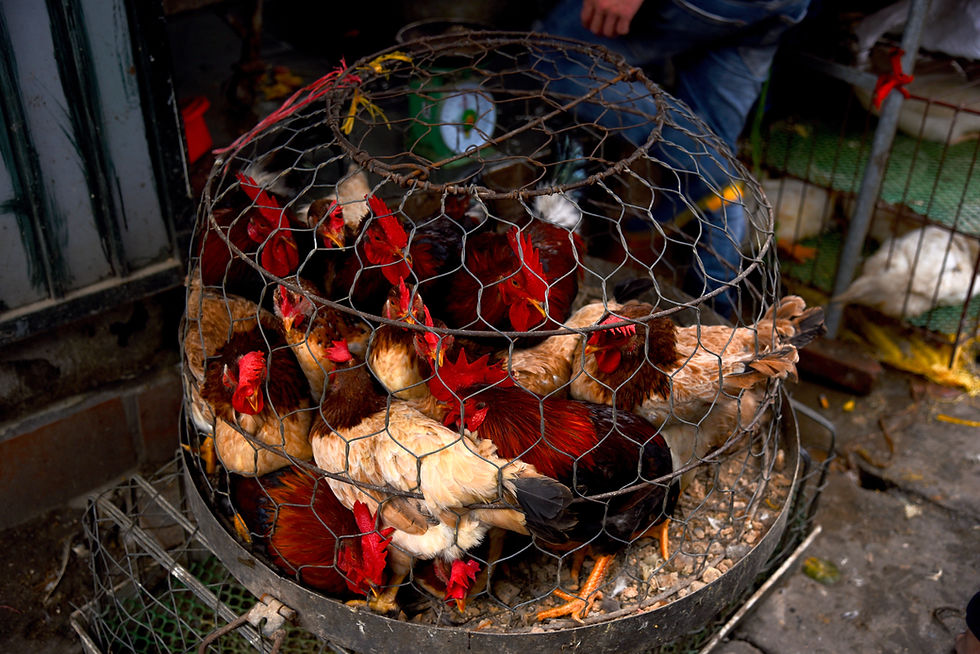
Chickens
The "Cage-Free" Myth
76 billion
42 to 47 days is the average lifespan
Roughly 76 billion chickens are killed for meat every year. This translates to more than 200 million chickens slaughtered every single day, making them the most heavily exploited land animal on Earth.
While a healthy backyard chicken can naturally live between 8 to 15 years, commercial meat chickens (broilers) are selectively bred to balloon in size so quickly that they reach market weight and are slaughtered at just 6 weeks of age.
400% faster growth rate since 1925
300 eggs per year vs. 15 in the wild
Due to intensive selective breeding, modern meat chickens grow more than three times faster than chickens raised in the 1950s. Their breast muscles grow so disproportionately large that their hearts, lungs, and legs cannot support the weight, causing widespread lameness and heart failure.
A wild junglefowl (the ancestor of the domestic chicken) naturally lays only 10 to 15 eggs per year for reproduction. Modern commercial egg-laying hens have been genetically manipulated to lay up to 300 eggs annually, which drastically depletes calcium from their bones, causing severe osteoporosis and fractures.
What are the primary welfare concerns and resource inefficiencies in industrial chicken farming?
Industrial chicken farming relies on severe confinement, specifically wire battery cages for egg laying hens and high density floor housing for meat broilers. Driven by intensive selective breeding, modern broiler growth rates have escalated by over 400 percent since 1957, causing severe systemic skeletal failure. Thermodynamically, poultry production requires 2 to 4 calories of human edible crop feed input to yield just 1 calorie of edible chicken meat.
While commercial packaging designs project images of open pastures, industry guidelines permit massive flocks of cage-free chickens to be intensely crowded on windowless warehouse floors.
Marketing vs. Reality
iPad-Sized Space
Accelerated Growth Velocity
99% Confinement Rate
24 Hour Lighting
Commercial egg battery cages allocate 67 square inches of floor area per hen, a space footprint mathematically smaller than a standard piece of tablet hardware or notebook paper.
Intensive selective breeding programs dropped broiler market lifecycles from 112 days down to fewer than 42 days while simultaneously more than doubling their final live weight.
Data from the Sentience Institute shows that over 99% of chickens raised for food live inside intensive factory farms, leaving fewer than 1 percent in pasture environments.
Poultry operations keep interior barn lights illuminated for up to 20 to 24 hours daily, artificially disrupting natural sleep cycles to force continuous feeding and faster weight gain.